Yoga Nidra: A Simple Guide to Yogic Sleep
August 19, 2026 · 10 min read
What is Yoga Nidra?
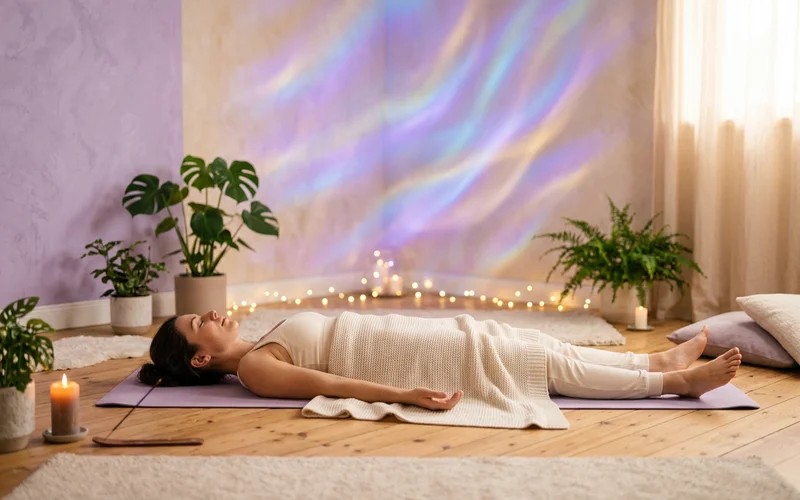
Yoga Nidra is a yoga technique thousands of years old, often referred to as yogic sleep. You lie comfortably on your back and are guided through a deep relaxation into a state between waking and sleeping. Unlike a classic guided meditation, in Yoga Nidra you remain conscious while your body comes completely to rest. This unique combination of deep calm and alert awareness makes Yoga Nidra one of the most effective relaxation techniques of all. Even a single Yoga Nidra session of 30 minutes can be as restful as several hours of sleep. It is no wonder that more and more people are discovering this yogic deep relaxation for themselves — whether in a yoga studio, online or as an audiobook at home.
Origin and history: from the Vedic tradition to today
The roots of Yoga Nidra reach back to the Vedic tradition and the ancient scriptures of Tantra. The term comes from Sanskrit and literally translates as the sleep of the yogi. In the 1960s, Swami Satyananda Saraswati, founder of the Bihar School of Yoga, developed a systematic method from these ancient teachings that is accessible to Western practitioners. Swami Satyananda Saraswati recognised that the various layers of consciousness a yogi passes through in sleep can be reached deliberately. His technique spread worldwide and to this day forms the basis for most Yoga Nidra exercises practised in yoga classes and studios.
More recently, Stanford research under the term NSDR (Non-Sleep Deep Rest) has drawn scientific attention to Yoga Nidra. NSDR describes the same process of conscious deep relaxation, but uses more modern, secular language. Whether you call it Yoga Nidra or NSDR — the effect on body and mind is the same.
How does Yoga Nidra work? The course of a Yoga Nidra session
A typical Yoga Nidra session follows a fixed sequence that leads you step by step to a deeper level of relaxation. You need no prior knowledge and no special equipment — just a comfortable surface and some quiet. The whole sequence lasts between 20 and 45 minutes.
Preparation and settling in
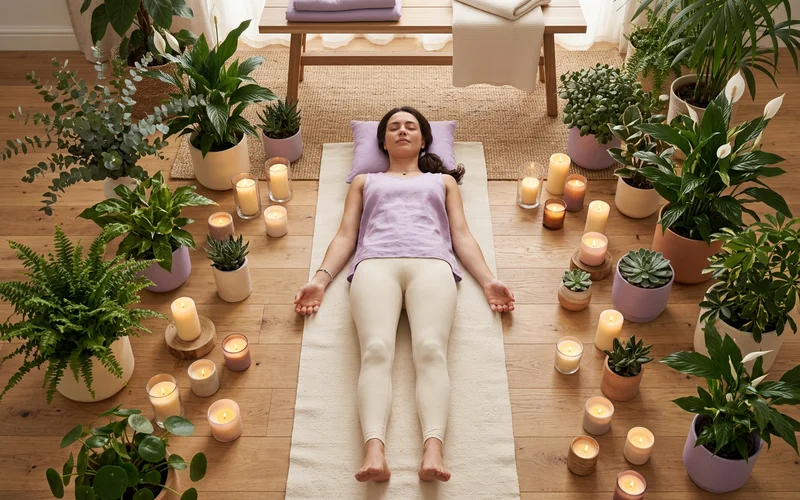
You lie on your back in the corpse pose (Shavasana), close your eyes and take a few deep breaths. The yoga teacher or narrator guides you to consciously relax your body and let go of all tension.
Sankalpa — your personal intention
A central element of Yoga Nidra is the Sankalpa. This is a short, positive sentence that you say to yourself inwardly — for example „I am calm and serene“ or „I trust my path.“ Sankalpas act like seeds that you plant in your subconscious. The deep relaxation of Yoga Nidra makes your mind especially receptive to these positive affirmations.
Body journey and body scan
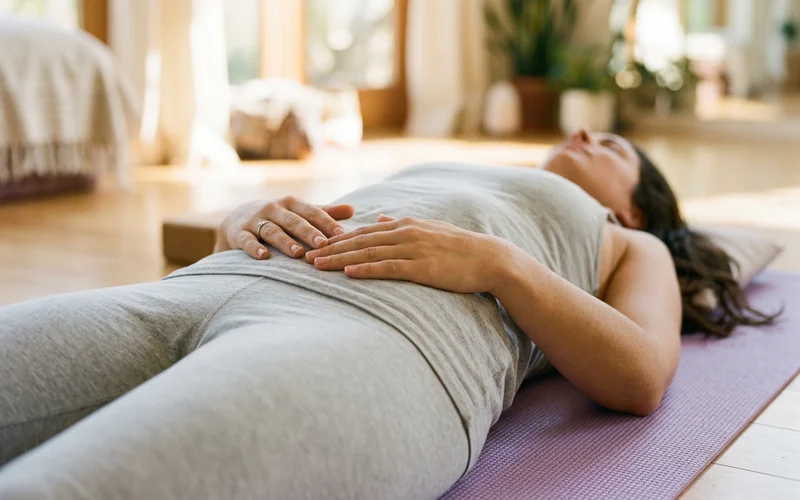
The yoga teacher now leads you through a systematic body journey in which you direct your attention to various parts of the body one after another. This body scan refines body awareness and leads to an even deeper relaxation. You feel how each muscle group releases, without having to do anything actively.
Breath and energy awareness
You observe your natural flow of breath without changing it. This conscious awareness of the breath calms the nervous system and deepens the state between waking and psychic sleep — a state that yogis describe as deep calm on a deeper level of consciousness.
Visualisation and images
In this phase the technique works with inner images and visualisation. You imagine certain scenes, colours or symbols that address different states of consciousness and emotions. This visualisation activates deeper layers of consciousness and promotes inner balance. This form of guided imagery also forms the basis of the fantasy journey for adults.
Closing and return
At the end you repeat your Sankalpa and slowly return to the waking state. Many practitioners report a feeling of deep inner calm and clarity after a Yoga Nidra session. Namaste — the Yoga Nidra practice is complete.
The effect of Yoga Nidra: what research shows
The effect of Yoga Nidra is well documented scientifically. Studies show that regular practice lowers stress hormones in the blood and activates the parasympathetic nervous system. Here are the most important benefits at a glance:
Stress reduction and burnout prevention
Yoga Nidra is one of the most effective methods for reducing stress. The guided deep relaxation measurably lowers the cortisol level and can provide supportive relief for burnout symptoms. Anyone who practises Yoga Nidra regularly reduces tension and strengthens resilience against chronic stress.
Better and deeper sleep
Yoga Nidra has been shown to improve sleep quality. The technique helps with falling asleep and promotes deeper sleep. Many users report that after an evening Yoga Nidra session they find restful sleep, even if they previously suffered from sleep problems.
Inner calm and emotional balance
Through working with states of consciousness and deepening body awareness, Yoga Nidra promotes inner calm and emotional stability. The inner balance that arises in the practice often carries over into everyday life.
Pain relief and healing
Several studies indicate that Yoga Nidra can relieve chronic pain. The state of psychic sleep — the conscious sleep state without fully falling asleep — allows the body to activate self-healing processes. In pain therapy, Yoga Nidra is therefore increasingly used as a complementary method.
Improved concentration
NSDR research shows that Yoga Nidra can increase the ability to absorb and learn. A short NSDR session after a learning phase has been shown to improve memory performance. Andrew Huberman, a neuroscientist at Stanford University, recommends NSDR as one of the most effective methods for regeneration and learning — making Yoga Nidra accessible even to people who have little connection to the term yoga.
Yoga Nidra vs. meditation: what are the differences?
Yoga Nidra and guided meditation are often confused, but they differ in important respects. In a classic guided meditation you sit upright and try to actively focus your mind — often on the breath, a mantra or body awareness. Yoga Nidra, on the other hand, you practise lying down, and the state of deep calm sets in by itself — you do not have to do anything actively. While guided meditation requires practice and discipline, Yoga Nidra is accessible from the start. Among the many meditation techniques, Yoga Nidra is therefore especially beginner-friendly: there is no „right“ or „wrong“, and even if you fall asleep, you benefit from the practice.
There are also differences compared with Yin Yoga. While in Yin Yoga you hold passive stretching poses for several minutes, in Yoga Nidra you lie completely still. Both practices complement each other wonderfully: a Yin Yoga session prepares body and mind ideally for a subsequent Yoga Nidra deep relaxation. Many yoga classes therefore combine Yin Yoga with Yoga Nidra for maximum relaxation. Yoga Nidra can also be used excellently as a complement to other relaxation exercises such as Autogenic Training or progressive muscle relaxation.
Who is Yoga Nidra suitable for?
The beautiful thing about Yoga Nidra: you need no prior knowledge, no flexibility and no special fitness. The technique is suitable for:
- Beginners looking for a gentle introduction to yoga and meditation techniques. Yoga Nidra is the perfect entry point, because you simply lie down and listen — no asanas, no pressure to perform.
- People with sleep problems looking for a natural path to more restful and deeper sleep.
- Those plagued by stress and at risk of burnout who want to integrate effective relaxation techniques into everyday life without investing much time.
- Yoga practitioners who want to expand their existing practice with a deep yoga technique — ideal as the conclusion of a yoga class or Yin Yoga session.
- Anyone who wants to strengthen their inner calm and inner balance without having to go to a yoga studio. Yoga Nidra works perfectly as online yoga or as audio guidance from home.
Yoga Nidra for falling asleep: your evening routine for better sleep
One of the most popular reasons to practise Yoga Nidra is its effect on sleep. If you cannot fall asleep in the evening or often wake up at night, Yoga Nidra for falling asleep can be a natural path to more sleep quality — entirely without medication.
The reason: Yoga Nidra deliberately leads you into the transition zone between waking and sleeping, the so-called hypnagogic state. In this phase, heartbeat and breathing slow down. Muscle tension releases and the nervous system switches from the sympathetic (tension) to the parasympathetic (recovery). Your body thus receives exactly the signals it needs to fall asleep — only this time consciously guided instead of forced. If you would like more on the sleep side, see our guide to music to fall asleep.
How to use Yoga Nidra as a sleep aid
The ideal falling-asleep routine with Yoga Nidra looks like this:
- Timing: Start your Yoga Nidra practice 20–30 minutes before your desired sleep time. Dim the lights and put your phone aside.
- Position: Lie directly in your bed instead of on a yoga mat. The goal, after all, is to glide seamlessly from the Yoga Nidra state into sleep.
- Sankalpa: Choose a sleep-related Sankalpa such as „I let go of the day and glide into deep, restful sleep.“
- Audio length: Choose a shorter session of 15–25 minutes. Many people fall asleep already during the body journey — and here that is expressly welcome.
- Regularity: The effect grows stronger with routine. After 1–2 weeks of daily practice, your brain automatically links the Yoga Nidra voice with the signal to fall asleep.
Studies show that Yoga Nidra shortens the time it takes to fall asleep and lengthens the deep-sleep phases. Especially with chronic sleep problems, many users report noticeable improvement after just a few days. Compared with sleep meditation or relaxation music, Yoga Nidra has the advantage that it actively moves through the levels of consciousness and therefore works more deeply than pure listening.
Practising Yoga Nidra at home: how to start
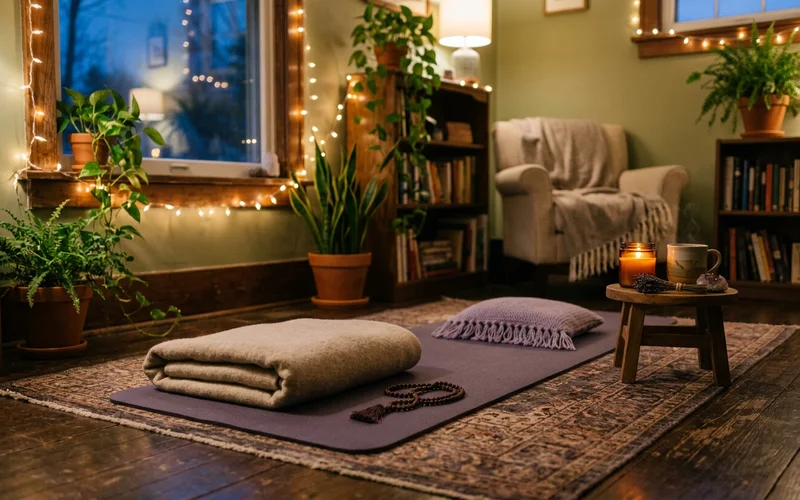
Would you like to try Yoga Nidra? Here is a simple guide for your first Yoga Nidra practice at home:
Choose a quiet place where you can be undisturbed for 20 to 45 minutes. Place a yoga mat or blanket on the floor and position yourself comfortably on your back. A cushion under the knees relieves the lower back, and a light blanket keeps you warm — because in deep calm the body cools down.
Start a guided Yoga Nidra deep relaxation — as an audiobook, an online yoga class or an app. Let the voice guide you without wanting to force anything. At the beginning, formulate your personal Sankalpa and repeat it inwardly with full conviction.
During the body journey and the body scan, simply follow the instructions. You do not have to do anything correctly — even if your thoughts wander, that is completely fine. Even if you briefly fall asleep, the Yoga Nidra practice continues to work on a deeper level.
After the Yoga Nidra session, take a moment to sense the state of deep calm. Slowly open your eyes, move your fingers and toes and return mindfully to everyday life. Many practitioners experience this moment as especially precious — a feeling of clarity and inner calm that can last for hours.
Matching audiobooks for your Yoga Nidra practice
To get started, we recommend professionally narrated relaxation audiobooks that guide you safely through all phases of the guided deep relaxation. Here are our recommendations:
Discover all relaxation audiobooks →
Guided relaxation & meditation albums
Autogenic Training 1 – Get long term power with the german self relaxation technique
Deep Trance Music: 432 Hz + 111 Hz Music for Meditation, Inner Balance and Sleep
Relaxing Zen Music – The Way of Water